Your scan result belongs to the domain, not to you
Scan a domain, close the tab, send the link to a colleague -- and until recently the colleague got a bare form, not your result. Only logged-in users who had saved a domain got a stored result; anonymous scans lived in a browser session and died with it. If a hundred people scanned the same domain in an hour, we probed that server a hundred times and remembered nothing.
That's last decade. That's backwards. A real health check measures the domain, not the person asking. SSL Labs and urlscan figured this out years ago -- the result belongs to the domain.
One living result per domain
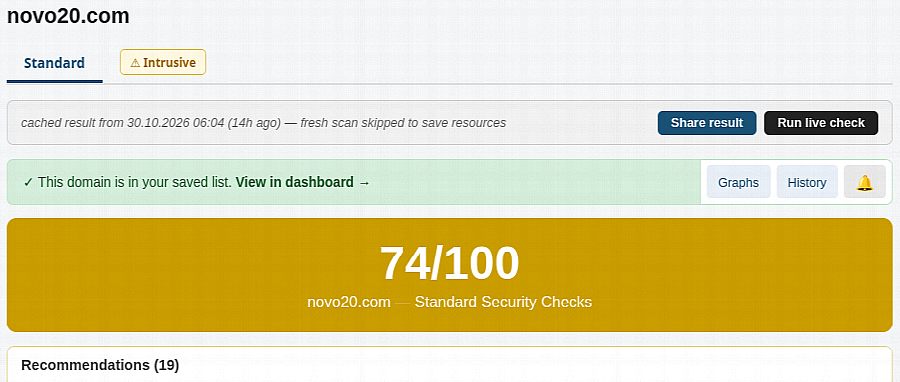
Every completed standard scan now writes a canonical per-domain report: one row per domain holding the latest usable result, stamped with the time the scan finished. Open /?domain=example.com -- logged in or not -- and you see it, with the age shown right in the banner: "cached result from 14:32 (12m ago)". No pretending it's fresh.
Anonymous scans finally survive too. The domain doesn't care who asked -- the scan ran, so the result exists. Once again, the result belongs to the domain, remember? A saved user's per-owner copy still keeps your private history; the canonical page is the public, shared truth.
What never lands in the store
A few rules keep the results consistent:
- Blocked, refused, or not-found runs are not verdicts. A firewall eating our scanner is an event, not the site's state -- those runs never become the public result. If a domain starts blocking us,
?domain=shows the last usable report with an honest "is blocking our scanner" banner on top, not a fake 0/100. - Fresher result always wins. Two jobs racing for the same domain can't regress the page -- a result that finished later takes the row.
- Intrusive results never go public. Deep-scan findings stay scoped to the verified owner, always. The public page is the standard scan only.
One scan serves everyone, for 15 minutes
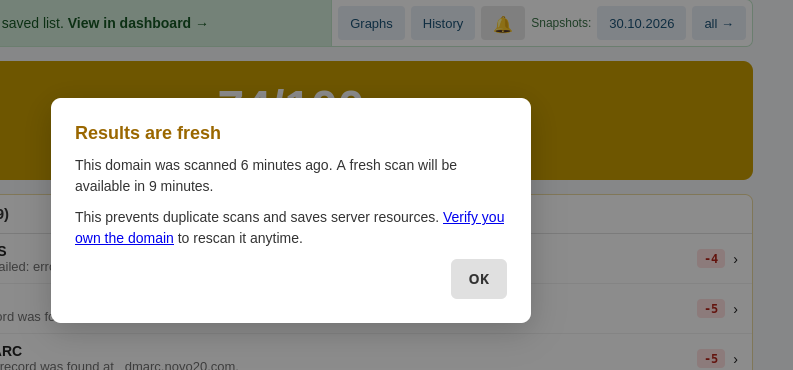
Rescans are throttled per domain, not per person. Inside the rescan window (default 15 minutes) a new submit gets the stored result with a "rescans allowed every 15 minutes" note -- a popular domain costs one scan per interval, not one per click. Verified owners of the domain skip the throttle entirely: prove it's yours and the "Run live check" button really means now. But only if you have an account and you verify the domain. If you are developing and debugging a website, get an account and verify -- it's free for one domain!
Frozen snapshot vs living document
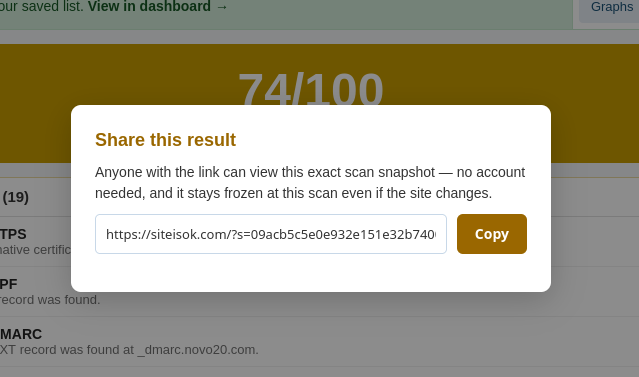
Two link types, two different promises. /?s=<token> shares are immutable snapshots -- byte-identical to what you saw, revocable, forever frozen at that moment. ?domain= is the living page: same result today, newer result tomorrow when someone rescans. Share the snapshot when "look at this exact failure" is the point; link the domain when "see how it's doing" is.